Applications Open for the Second Basic Mountaineering Workshop 2026
A week-long foundation programme for aspiring mountain guides.
Technical ability, sound judgement, and professional conduct are essential qualities for anyone working in the mountains. While experience remains invaluable, today's climbing industry also demands structured training that develops the skills required to operate safely and responsibly in high-altitude environments.
Beginning 15 August, 14 Peaks Mountaineering Institute will deliver its Second Basic Mountaineering Workshop, a week-long programme designed for aspiring mountain guides seeking practical instruction in modern mountaineering techniques and professional mountain practices.
The workshop is made possible through Founding Funding from Fortis, with Operational Support from Heli Everest and Technical Support from Marmot. Together, these partnerships help expand access to high-quality mountain education for talented individuals who are preparing for careers in Nepal's mountaineering industry.
The Basic Mountaineering Workshop has been developed as an introductory programme that establishes the technical foundation required before progressing to more advanced mountain training.
Delivered through a combination of classroom sessions and field-based exercises at multiple training locations around Kathmandu, the programme emphasises practical learning, technical competency, and professional responsibility.
The workshop is led by Oswaldo "Ossy" Freire, whose experience in technical skills development helps participants build confidence through structured instruction and repeated practical application.
With 30 fully funded places available, the programme is intended for individuals who demonstrate commitment, curiosity, and a genuine interest in developing as mountain professionals.
Participants who successfully complete the workshop will receive a Certificate of Completion.
Programme
Second Basic Mountaineering Workshop
Start Date
15 August, 2026
Duration
7 days
Participants
30 Selected Applicants
Lead Instructor
Oswaldo "Ossy" Freire
Programme Format
Classroom Learning & Field-Based Training
Location
Multiple Training Locations Around Kathmandu
Tuition
Fully Funded
Recognition
Certificate of Completion
The curriculum introduces participants to the knowledge and practical skills required for safe movement in mountain environments while establishing the professional standards expected throughout the climbing industry.
The workshop begins with an overview of mountaineering as both a profession and a discipline.
Participants explore the history of mountaineering, course methodology, sports ethics, and the responsibilities associated with working in high-altitude environments.
This provides the context for the technical instruction that follows.
Participants receive practical instruction on the proper use of fundamental mountaineering equipment used during fixed-rope travel.
Training focuses on developing familiarity with equipment systems while understanding their safe and effective application in mountain terrain.
Safety remains central to every aspect of mountaineering.
This module introduces participants to hazard identification, route planning, terrain assessment, changing mountain conditions, and emergency procedures used during climbing operations.
Developing sound judgement is emphasised alongside technical competence.
Reliable equipment requires consistent inspection and care.
Participants learn the principles of equipment maintenance, recognising wear, understanding replacement schedules, and adopting practices that contribute to safer climbing operations.
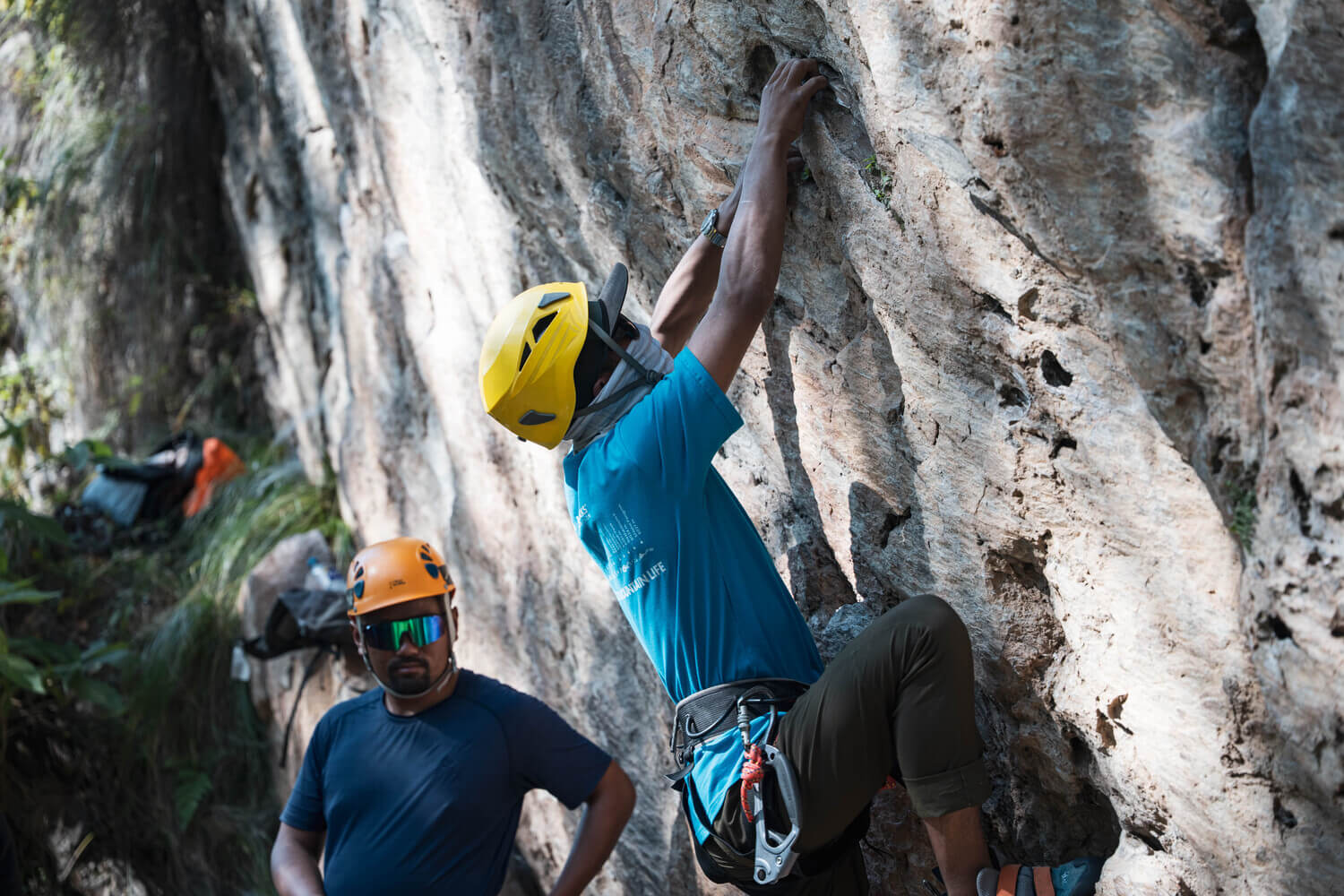
Participants develop the practical techniques required to move efficiently on fixed ropes through supervised field exercises.
Topics include:
- Basic progression techniques
- Rope transitions
- Movement efficiency
- Rope management
- Safe climbing practices
These skills form the technical foundation for future advanced instruction.
The programme introduces the principles of short-rope travel, communication, and coordinated team movement used in a variety of mountain environments.
Participants practice maintaining efficient movement while prioritising safety and teamwork.
Descending safely requires the same level of technical precision as ascending.
Participants are introduced to:
- Standard rappelling techniques
- Assisted rappel procedures
- Controlled descent
- Rope management during descent
Repeated practical sessions allow participants to build confidence through supervised practice.
The workshop provides an introduction to crevasse rescue systems and the principles of emergency response during glacier travel.
Participants become familiar with rescue procedures, communication, teamwork, and the structured approach required when responding to incidents in glaciated terrain.
Participants also develop practical movement skills applicable across varied mountain terrain.
Exercises are designed to improve efficiency, balance, confidence, and decision-making while travelling in technical environments.
Early response plays an important role during mountain emergencies.
Participants are introduced to the fundamentals of wilderness first aid, including casualty assessment, gathering information for medical professionals, communication during emergencies, and preparation for evacuation.
Professional mountain guides have a responsibility to protect the environments in which they work.
Participants learn the principles of Leave No Trace, local mountain regulations, responsible waste management, and sustainable practices that support long-term conservation of Nepal's mountain landscapes.
Technical ability is only one part of becoming a capable mountain professional.
The workshop concludes by examining the standards of professional behaviour expected when working with clients, teammates, expedition staff, and colleagues.
Leadership, communication, respect, accountability, and teamwork are integrated throughout the programme.
The Second Basic Mountaineering Workshop has been designed as an entry point for aspiring mountain guides seeking structured technical education.
Participants who successfully complete the programme will have developed a stronger understanding of mountain safety, technical systems, environmental responsibility, and professional conduct while establishing a foundation for continued learning.
The workshop also serves as an appropriate pathway for individuals who intend to pursue more advanced training through the Institute's fully funded cohort programme, where selected participants receive extended instruction in technical mountaineering, rescue systems, leadership, and wilderness medicine.
14 Peaks Mountaineering Institute was established to expand access to technical mountain education for Nepal's climbing community.
Its programmes are built around practical instruction, experienced faculty, and field-based learning that reflects the realities of modern Himalayan expeditions. By removing financial barriers and delivering structured technical education, the Institute seeks to strengthen safety, professionalism, and long-term opportunities within Nepal's mountaineering industry.
Applications for the Second Basic Mountaineering Workshop are now open.
The programme begins on 15 August, runs for one week, and offers 30 fully funded places for aspiring mountain guides.
The Institute's approach remains consistent across every programme:
We don't just teach people to climb mountains-we prepare them to lead safely, professionally, and responsibly.