Basic Mountaineering Workshop 2026: Building Safer and More Skilled Mountain Professionals
August 15–21, 2026 | 14 Peaks Mountaineering Institute Pvt. Ltd.
Mountains demand more than physical strength.
They demand technical knowledge, sound judgment, teamwork, discipline, and the ability to make the right decision when conditions become difficult. In high-altitude environments, where weather can change rapidly and small mistakes can have serious consequences, proper training is not simply an advantage—it is an essential part of mountain safety.
Recognizing this need, 14 Peaks Mountaineering Institute Pvt. Ltd. organized the second Basic Mountaineering Workshop 2026, held from August 15 to 21, 2026.
The seven-day program brought together Sherpas working on 8,000-meter expeditions, beginner mountaineers, and Nepali doctors, creating a diverse learning environment where Himalayan experience, technical instruction, and medical perspectives came together.
Led by IFMGA Guide Oswaldo “Ossy” Freire, the workshop provided participants with a structured and practical introduction to essential mountaineering techniques, safety systems, risk management, rope skills, and basic rescue procedures.
Rather than focusing solely on theory, the program progressively moved participants from controlled climbing environments to realistic outdoor exercises, allowing them to apply what they learned in practical situations.
Every strong mountaineering journey begins with the fundamentals.
The initial stage of the workshop focused on developing participants' understanding of mountaineering equipment, terminology, and safety principles.
Participants were introduced to basic rope terminology and essential personal protective equipment, including harnesses, helmets, carabiners, anchor tethers, and rappel and belay devices.
However, the training went beyond simply identifying equipment.
Participants learned the importance of proper equipment fitting, inspection, and systematic checks. In the mountains, technical equipment can only provide protection when it is correctly selected, properly fitted, regularly inspected, and used according to established procedures.
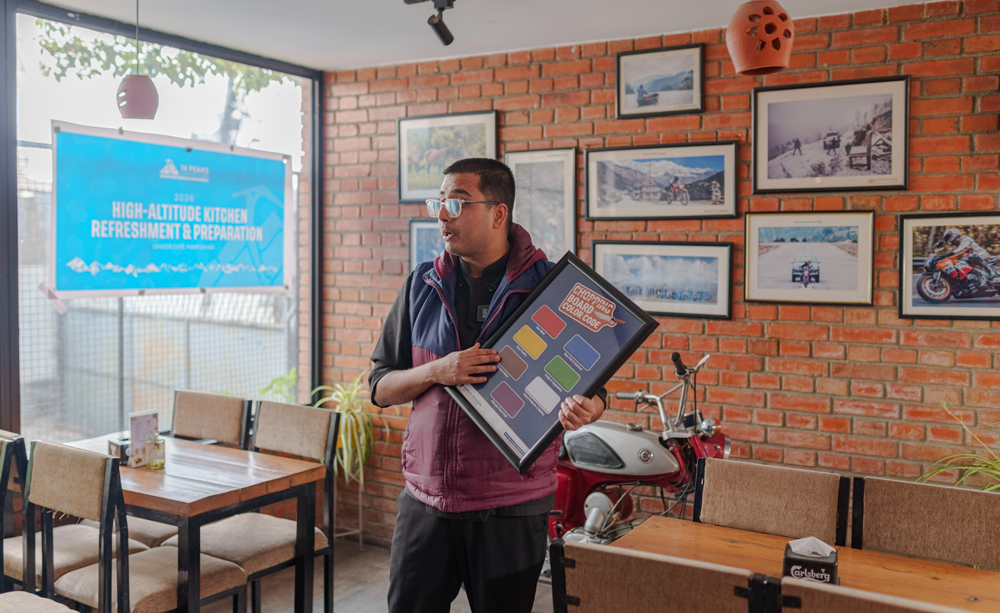
The workshop also introduced hazard identification, route planning, and the 3×3 risk assessment method. These sessions encouraged participants to think ahead—recognizing potential hazards before entering complex terrain and evaluating risks based on changing environmental and operational conditions.
The underlying message was clear: good mountaineering begins with good preparation and good decisions.
The first three days of the workshop were conducted at the Pasang Lhamu Wall Climbing Center in Dhumbarahi, providing a controlled environment where participants could develop and practice fundamental technical skills.
As the sessions progressed, participants were introduced to more advanced rope and movement systems.
Training included fixed-rope systems, communication and movement discipline, and an introduction to short-roping. Participants also practiced a range of belay techniques, including hand, shoulder, and waist belays, along with body, anchor, and terrain belay techniques.
These exercises demonstrated an important reality of mountain travel: technical ability alone is not enough.
A rope system is only as effective as the people operating it. Clear communication, coordination, discipline, and awareness of other team members are critical to maintaining safety.
For professionals working on major Himalayan expeditions, these seemingly fundamental skills can become crucial when operating in challenging terrain, under pressure, and with limited margins for error.
After establishing the technical foundation at the climbing center, the workshop moved outdoors.
Days four and five were conducted at Jagdol, where participants had the opportunity to apply their skills in a more realistic mountain environment.
One of the key areas of training was fixed-rope descent. Participants received detailed instruction on rappel equipment, system setup, and safety checks before practicing descent techniques.
The group also practiced tandem rappelling, allowing participants to understand the additional technical and communication considerations involved when two people move together on a rope system.
Moving from an indoor climbing facility into an outdoor environment introduced a new dimension to the training. Participants had to apply their knowledge while considering terrain, movement, communication, equipment management, and the practical realities of working outside a controlled setting.
The transition from theory to practice was an essential part of the workshop.
It helped participants develop not only technical competence but also confidence in applying those skills responsibly.
For anyone working in the high mountains, understanding hazards is fundamental.
Among the most serious dangers encountered in glaciated terrain are crevasses—hidden or visible fractures in glaciers that can present significant risks to climbers and expedition teams.
The workshop therefore dedicated important attention to crevasse hazards and basic rescue procedures.
Participants were introduced to anchor systems and load-transfer concepts, developing an understanding of how forces are managed within rope-rescue systems.
They also explored the fundamentals of pulley systems and specialized rope manoeuvres relevant to basic mountain rescue and technical rope work.
The objective was not simply to teach participants a collection of techniques, but to help them understand the principles behind those systems.
In an emergency, understanding why a system works can be just as important as remembering how to construct it.
Emergency protocols were also emphasized throughout the training. Participants were encouraged to remain calm, communicate clearly, follow established procedures, and work systematically rather than allowing pressure to dictate their decisions.
In the mountains, a calm and organized response can make a critical difference.
A major strength of the workshop was the experience and diversity of its instructional team.
The training was led by IFMGA Guide Oswaldo “Ossy” Freire, whose international guiding experience brought a strong technical and professional perspective to the program.
He was supported by Jenjen Lama, a National Mountain Guide, along with experienced Nepali mountain professionals Fura Tshering Sherpa, Pasang Sherpa, and Tenging Gyaljen Sherpa.
Together, the instructional team brought different perspectives from technical climbing, guiding, Himalayan expeditions, mountain safety, and practical rope systems.
This combination of international guiding expertise and firsthand Himalayan experience provided participants with valuable insight into the realities of working in demanding mountain environments.
For Sherpas preparing for 8,000-meter expeditions, beginners taking their first steps into mountaineering, and medical professionals who may work in mountain environments, this exchange of knowledge was particularly valuable.
The final two days of the workshop were held at Crimpanzee Adventure Hub, Chuchepati, where participants consolidated the knowledge and practical skills developed throughout the week.
By this stage, the participants had progressed through equipment familiarization, rope systems, belaying, fixed-rope movement, rappelling, risk assessment, crevasse awareness, and basic rescue concepts.
Day seven included an examination and evaluation, providing an opportunity to assess participants' understanding and practical application of the skills covered during the program.
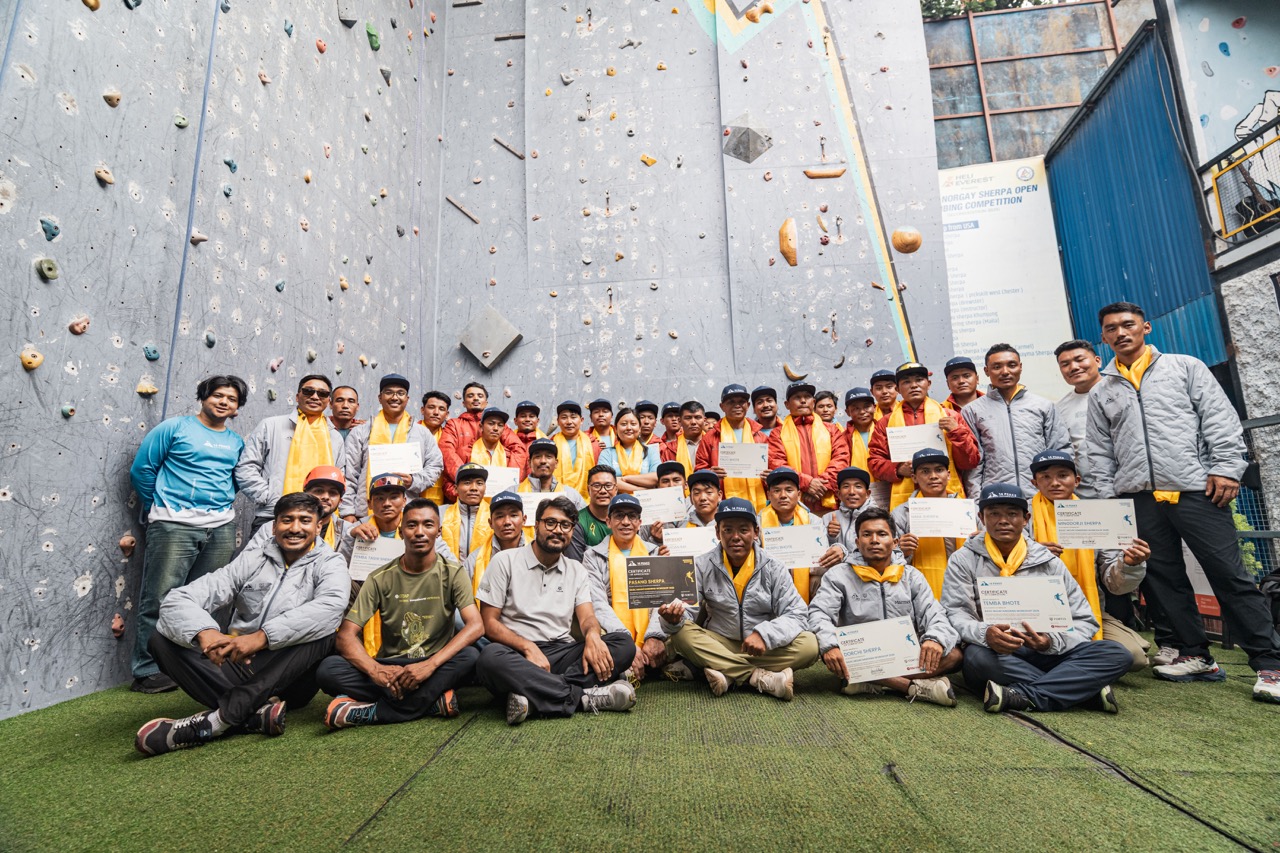
The workshop concluded with a closing program and certificate distribution ceremony, recognizing the participants for successfully completing the Basic Mountaineering Workshop 2026.
The certificates represented more than the completion of a seven-day course. They marked a commitment to continued learning, responsible mountain practice, and the pursuit of safer expedition environments.
The Basic Mountaineering Workshop 2026 was designed to be more than a course about ropes and equipment.
At its heart was a broader philosophy of mountain safety and professional development.
Participants learned to approach mountain environments through several interconnected principles:
- Technical competence — understanding and correctly applying climbing and rope systems.
- Risk awareness — identifying hazards before they become emergencies.
- Decision-making — evaluating conditions and making informed choices.
- Communication — maintaining clear and effective communication within a team.
- Teamwork — understanding that mountain safety is a shared responsibility.
- Emergency preparedness — responding systematically when situations become critical.
- Equipment discipline — inspecting, maintaining, and using technical equipment correctly.
These principles are particularly important in the Himalayas, where expedition teams regularly operate in complex and demanding environments.
Nepal's mountains are not only destinations for climbers from around the world. They are also workplaces for thousands of mountain professionals who support expeditions, guide climbers, provide medical assistance, manage logistics, and respond to emergencies.
As Himalayan mountaineering continues to evolve, the need for well-trained, technically capable, and safety-conscious mountain professionals becomes increasingly important.
Training programs such as the Basic Mountaineering Workshop help create opportunities for professionals and aspiring mountaineers to strengthen their capabilities in a structured environment.
For Sherpas preparing to work on 8,000-meter peaks, these skills can support safer expedition operations.
For beginners, they provide a responsible foundation for entering the world of mountaineering.
For doctors and other professionals working around high-altitude expeditions, they provide a better understanding of the technical environment in which mountain teams operate.
The mountains will always carry risk.
No training program can eliminate every hazard, and no technique can replace sound judgment. But knowledge, preparation, teamwork, and disciplined decision-making can significantly improve the way people respond to those risks.
The Basic Mountaineering Workshop 2026 represents one step toward that goal.
By bringing together experienced Sherpas, aspiring mountaineers, medical professionals, national guides, and an IFMGA instructor, the program created a platform for knowledge sharing and practical learning.
More importantly, it reinforced a simple but powerful idea:
The stronger our skills, the better prepared we are to protect ourselves and each other in the mountains.
Through initiatives such as this, 14 Peaks Mountaineering Institute Pvt. Ltd. continues to contribute to the development of a more capable, confident, and safety-conscious mountain community in Nepal.
Because the future of Himalayan mountaineering is not only about reaching higher.
It is about climbing smarter, working together, and coming home safely.